How to Analyze a Commercial Property Before You Buy: A Checklist for Investors
A practical due diligence checklist for Miami investors: income and expenses, cap rate and DSCR, leases and vacancy risk, inspections, zoning, and financing.
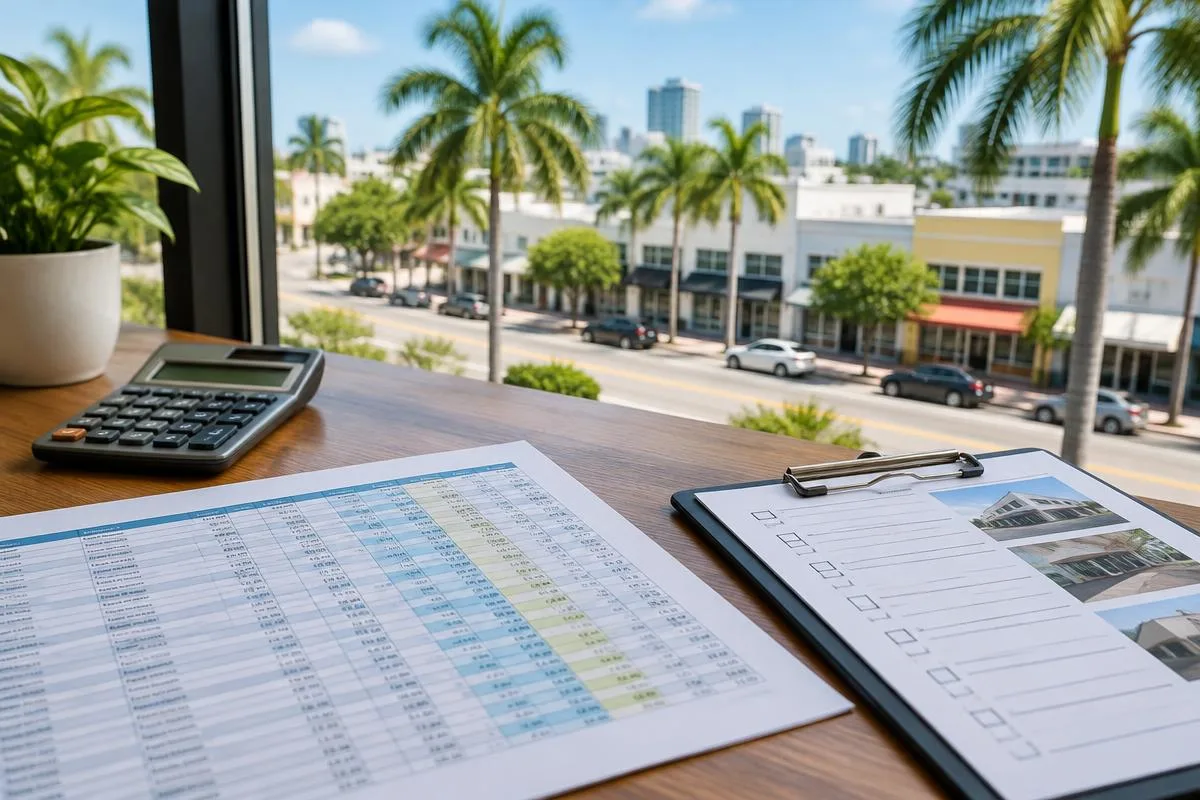
Buying a commercial property can be a significant investment, but finding a building in a desirable location is only the beginning. Before making a purchase, investors need to understand the property's financial performance, physical condition, tenants, market position, and potential risks.
A retail shopping center with strong occupancy may appear attractive until you discover that several leases are about to expire. A multifamily building may generate substantial rental income but also require expensive repairs. A vacant commercial building may offer an opportunity to increase its value, but only if the anticipated improvements and leasing assumptions are realistic.
In Miami and South Florida, commercial real estate investors must also consider local market conditions, property taxes, insurance expenses, zoning regulations, and the requirements of the intended investment strategy.
Whether you are evaluating your first investment property or expanding an existing portfolio, the objective should be the same: understand what you are buying, how the property generates income, what it will cost to operate, and which risks could affect your return.
As a commercial real estate professional working with investors, landlords, and business owners in Miami, I believe a disciplined property analysis is one of the most important steps before committing to a purchase.
Here is a practical checklist to help investors evaluate a commercial property before buying.
1. What Should You Evaluate First When Analyzing a Commercial Property?
Start by understanding the property's location, type, occupancy, physical characteristics, asking price, and investment potential.
Before reviewing complicated financial projections, determine whether the property fits your investment objectives.
An investor seeking predictable rental income may prefer a stabilized property with established tenants. Another investor may be interested in a vacant building that can be renovated, leased, or repositioned.
Neither strategy is automatically better. They involve different levels of risk, capital requirements, and management responsibilities.
Questions to ask during the initial evaluation
- Where is the property located, and what surrounds it?
- What type of commercial property is it?
- Is it fully leased, partially occupied, or vacant?
- What is the asking price?
- How much building and land area is included?
- What is the property's current condition?
- What improvements may be required?
- Who are the existing tenants?
- Does the property have income-growth potential?
- Does the investment fit your available capital and risk tolerance?
For example, a retail property along West Flagler Street may benefit from an established commercial corridor, but its investment potential still depends on tenant demand, lease terms, expenses, and acquisition price.
Similarly, an industrial building in Doral may offer a desirable location for certain users, but its functionality, loading access, and condition remain important.
A good location cannot compensate for every financial or operational problem.
2. How Do You Analyze a Commercial Property's Income and Operating Expenses?
To evaluate an income-producing commercial property, review its actual rental income, vacancy, operating expenses, and net operating income rather than relying solely on the seller's advertised figures.
A property's financial performance is central to its investment value.
However, the income shown in marketing materials may differ from the income the property actually collects.
For example, a rent roll may show the monthly rent required under each lease, but that does not necessarily mean every tenant is paying on time.
Likewise, operating expense estimates may exclude costs that a buyer will need to consider.
What is net operating income?
Net operating income, commonly called NOI, measures a property's operating income after deducting operating expenses.
A simplified calculation is:
Net Operating Income = Effective Gross Income − Operating Expenses
Effective gross income generally reflects potential rental and other property income after accounting for vacancy and collection losses.
Operating expenses may include property taxes, insurance, maintenance, utilities paid by the owner, management, and other ordinary property operating costs.
NOI generally excludes mortgage payments, income taxes, depreciation, and capital expenditures.
Example of an income analysis
Consider a hypothetical commercial property with the following annual financial performance.
| Financial Item | Annual Amount |
|---|---|
| Potential rental and other income | $240,000 |
| Vacancy and collection allowance | −$12,000 |
| **Effective gross income** | **$228,000** |
| Property taxes | −$32,000 |
| Insurance | −$18,000 |
| Repairs and maintenance | −$15,000 |
| Property management | −$10,000 |
| Utilities and other operating expenses | −$13,000 |
| **Net operating income** | **$140,000** |
This is a hypothetical example, not a representation of typical Miami property income or expenses.
The investor should verify actual records and develop reasonable projections for future ownership.
Why financial verification matters
Before buying, request available supporting records such as operating statements, rent rolls, lease agreements, property tax bills, insurance information, and relevant expense records.
For a property with CAM or other operating expense reimbursements, review which expenses tenants are contractually required to pay and whether reimbursements have been collected and reconciled correctly.
Do not assume that a property advertised as NNN automatically transfers every operating expense or capital obligation to the tenants.
The lease language determines the actual responsibilities.
3. How Do You Calculate Cap Rate, Cash-on-Cash Return, and Other Investment Metrics?
Commercial property investors commonly use capitalization rate, cash-on-cash return, and debt service coverage ratio to evaluate potential returns and financing risk.
Each metric answers a different question.
Capitalization rate
The capitalization rate compares a property's net operating income with its purchase price or value.
Cap Rate = Annual NOI ÷ Purchase Price
Using the hypothetical NOI of $140,000 from the previous example, assume the property has a purchase price of $2,000,000.
The capitalization rate would be:
$140,000 ÷ $2,000,000 = 7%
This is an illustrative calculation, not a current Miami market capitalization rate.
Cap rates can help compare properties, but they do not account for financing costs or all future capital requirements.
Cash-on-cash return
Cash-on-cash return measures annual before-tax cash flow relative to the investor's actual cash invested.
Cash-on-Cash Return = Annual Before-Tax Cash Flow ÷ Total Cash Invested
Assume the following hypothetical financing arrangement:
- Purchase price: $2,000,000.
- Loan amount: $1,400,000.
- Down payment: $600,000.
- Closing costs and initial capital investment: $100,000.
- Total cash invested: $700,000.
- Annual NOI: $140,000.
- Annual debt service: $105,000.
The annual before-tax cash flow would be:
$140,000 − $105,000 = $35,000
Cash-on-cash return:
$35,000 ÷ $700,000 = 5%
This example assumes no additional below-the-line cash expenditures beyond those stated. Actual cash flow may be reduced by capital expenditures, leasing costs, and other obligations.
Debt service coverage ratio
The debt service coverage ratio, or DSCR, measures how much net operating income is available relative to annual debt service.
DSCR = Annual NOI ÷ Annual Debt Service
Using the same example:
$140,000 ÷ $105,000 = 1.33
A DSCR of approximately 1.33 means the property generates about $1.33 of NOI for each $1.00 of annual debt service.
Lenders establish their own underwriting requirements, and acceptable DSCR levels vary by loan program, property, and risk.
What does each metric tell you?
| Metric | What It Measures | Main Limitation |
|---|---|---|
| Cap rate | Unleveraged income relative to price or value | Excludes financing and future capital expenditures |
| Cash-on-cash return | Annual before-tax cash flow relative to invested cash | Depends on financing and cash-flow assumptions |
| DSCR | Income available to cover debt payments | Does not capture every investment risk |
| Price per square foot | Purchase price relative to property size | Does not directly measure profitability |
| Loan-to-value ratio | Loan amount relative to property value | Does not independently establish affordability |
No single metric provides a complete investment analysis.
A property with an attractive cap rate may still require substantial repairs or have tenants whose leases expire soon.
Investors should evaluate the numbers together.
4. How Do You Evaluate Tenants, Leases, and Vacancy Risk?
Review every existing lease, verify tenant payment performance, and evaluate how lease terms could affect income after the purchase.
For income-producing commercial real estate, tenants are a major part of the investment.
A fully occupied property may appear stable, but occupancy alone does not establish the quality of the income.
What should you review in commercial leases?
Important items include:
- Current base rent and additional rent.
- Lease commencement and expiration dates.
- Renewal and extension options.
- Scheduled rental increases.
- Security deposits.
- Tenant improvement obligations.
- Maintenance and repair responsibilities.
- CAM, tax, and insurance reimbursement provisions.
- Assignment and subletting rights.
- Purchase options or rights of first refusal.
- Termination rights and other unusual provisions.
Investors should also review amendments, side letters, and other documents affecting the original lease.
Why tenant estoppels matter
A tenant estoppel certificate can help confirm specified facts about the lease, such as the rental amount, security deposit, lease term, and whether the tenant claims certain landlord defaults.
The scope and availability of an estoppel depend on the lease and transaction.
Estoppels do not replace a complete review of the lease documents.
What happens when leases expire?
A lease expiration may create an opportunity to increase rent, but it can also create vacancy risk.
If a tenant leaves, the owner may need to pay for improvements, leasing commissions, marketing, and operating costs while the space is vacant.
Investors should estimate the financial impact of possible tenant turnover.
For Miami retail properties, the ability to attract replacement tenants may depend on location, visibility, parking, permitted uses, property configuration, and market demand.
These factors should be evaluated before assuming vacant space can be leased immediately.
5. What Physical, Environmental, and Zoning Due Diligence Should Investors Complete?
Investors should investigate the property's physical condition, environmental risks, legal access, zoning, and other regulatory requirements before the applicable due diligence deadline.
A property can have attractive financial projections but still require substantial unexpected expenditures.
Physical inspections
Depending on the building, professional inspections may address:
- Roof condition.
- Structural components.
- HVAC systems.
- Electrical systems.
- Plumbing.
- Fire and life-safety systems.
- Elevators, if applicable.
- Parking areas and drainage.
- Building accessibility.
- Deferred maintenance.
The appropriate inspection scope depends on the property type and transaction.
A commercial property condition assessment may be useful for larger or more complex assets.
Environmental due diligence
A Phase I Environmental Site Assessment may help identify recognized environmental conditions associated with the property.
Environmental reviews are particularly important when a property's current or historical uses could involve hazardous substances or petroleum products.
A Phase I assessment does not guarantee that a property is free from contamination.
Additional investigation may be recommended depending on the findings.
Investors should coordinate environmental due diligence with qualified professionals and their lender when applicable.
Zoning and permitted uses
Zoning determines many of the uses and development activities that may be permitted on a property, subject to other regulations and approvals.
In the City of Miami, Miami 21 establishes the city's zoning framework.
Other municipalities and unincorporated Miami-Dade County have different applicable zoning rules.
Investors should verify zoning, legal use, open permits, code violations, and development restrictions with the appropriate authorities.
For example, purchasing a commercial building with the intention of converting it to a restaurant may require evaluating permitted uses, building improvements, parking requirements, fire safety, and other approvals.
A property's prior use does not automatically guarantee approval for a proposed new use.
6. How Do You Analyze Location, Market Demand, and Future Rental Potential?
Investors should evaluate whether the property's location supports its current use, future leasing prospects, and long-term investment objectives.
Location affects more than convenience.
For commercial real estate, it can influence tenant demand, operating performance, accessibility, and potential resale opportunities.
What location factors should investors consider?
For retail properties, evaluate visibility, nearby businesses, access, parking, and the customer base.
For industrial properties, consider transportation routes, loading access, property configuration, and proximity to relevant business activity.
For office properties, consider accessibility, building functionality, parking, and demand from prospective occupants.
For multifamily properties, evaluate residential demand, surrounding amenities, operating costs, and relevant property conditions.
For commercial land, review access, utilities, zoning, surrounding development, and potential restrictions.
How should you evaluate future rent growth?
Future rent increases should be supported by market evidence and applicable lease provisions.
An investor should not assume that every tenant can immediately be charged the highest advertised rental rate in the area.
Existing leases may limit when rents can change.
Even after a lease expires, achieving higher rent may require tenant improvements, concessions, marketing time, or additional leasing expenses.
A realistic analysis considers both potential income and the costs required to achieve it.
Investors should compare the property's current rents with relevant market information and distinguish actual income from projected income.
7. How Do Financing, Property Taxes, Insurance, and Closing Costs Affect the Investment?
Investors should analyze the complete acquisition cost and expected financing terms because a property's purchase price is only one part of the required investment.
Financing can materially affect annual cash flow.
The amount borrowed, interest rate, amortization schedule, and loan conditions all influence the investor's financial obligations.
Financing considerations
Before purchasing, review:
- Available loan amount.
- Required down payment.
- Interest rate and loan term.
- Amortization schedule.
- Debt service.
- Prepayment restrictions.
- Required reserves.
- Lender fees.
- Potential refinancing risk.
Commercial loans may have different structures from residential mortgages, including shorter terms or balloon payments.
Investors should understand how the loan will be repaid or refinanced.
Florida property taxes
In Miami-Dade County, an ownership change can affect future assessed property values and property taxes.
An investor should not automatically assume that the seller's current property tax bill will remain unchanged after closing.
Future taxes should be evaluated using appropriate assumptions and information from the relevant property appraiser and tax authorities.
Insurance expenses
Commercial property insurance costs depend on factors such as building characteristics, location, coverage, and underwriting requirements.
Investors should obtain relevant insurance quotes before relying on projected operating expenses.
Closing costs and reserves
Acquisition costs may include title and settlement charges, inspections, legal fees, lender expenses, and other transaction-specific items.
Investors should also consider reserves for repairs, tenant improvements, vacancy, and unexpected expenditures.
A property that appears affordable based on the down payment alone may require substantially more cash to operate successfully.
8. What Is the Complete Commercial Property Investment Checklist Before Buying?
A structured checklist helps investors organize due diligence, identify missing information, and compare potential acquisitions.
The following checklist can be adapted to retail, office, industrial, multifamily, and other commercial investment properties.
Commercial property acquisition checklist
Property and market
- Confirm property address, parcel identification, and ownership.
- Verify building and land square footage.
- Review location, access, and surrounding commercial activity.
- Compare relevant recent sales and competing properties.
- Evaluate current and potential tenant demand.
Financial performance
- Obtain and review the current rent roll.
- Review historical operating statements.
- Verify rental income and other property revenue.
- Review property taxes and insurance expenses.
- Calculate net operating income.
- Analyze cap rate and cash-on-cash return.
- Prepare conservative cash-flow projections.
Tenants and leases
- Review executed leases and amendments.
- Confirm rental amounts and expiration dates.
- Evaluate tenant payment history.
- Review CAM and other reimbursement provisions.
- Identify renewal options and unusual tenant rights.
- Request appropriate tenant estoppels.
- Evaluate vacancy and rollover risk.
Physical and legal due diligence
- Complete appropriate building inspections.
- Evaluate roof, HVAC, electrical, and plumbing systems.
- Review available surveys and title information.
- Investigate environmental conditions as appropriate.
- Verify zoning and permitted uses.
- Check available permit and code enforcement records.
- Estimate near-term capital expenditures.
Financing and closing
- Obtain preliminary financing terms.
- Calculate required equity and total acquisition costs.
- Review projected debt service and DSCR.
- Estimate property tax changes after acquisition.
- Obtain appropriate insurance estimates.
- Establish operating and capital reserves.
- Review contractual contingencies and deadlines with counsel.
What Mistakes Should Commercial Property Investors Avoid?
Even a property with attractive projected returns can become a difficult investment if important risks are overlooked.
Here are six common mistakes to avoid:
- Relying only on the advertised cap rate. Verify the NOI and the assumptions behind the calculation.
- Using the seller's current property tax bill without adjustment. A change in ownership may affect future taxes.
- Ignoring lease expiration dates. Tenant turnover can create vacancy, improvement costs, and reduced income.
- Underestimating repairs and capital expenditures. Building systems and deferred maintenance can materially affect returns.
- Assuming projected rents are guaranteed. Market conditions, tenant demand, and leasing expenses influence achievable income.
- Skipping professional due diligence. Physical, environmental, title, and zoning issues may not be apparent from marketing materials.
A disciplined investment analysis does not eliminate risk, but it can help investors understand the risks before making a financial commitment.
Looking to Buy Commercial Investment Property in Miami?
If you are considering purchasing a retail building, shopping center, industrial warehouse, office property, multifamily investment, or commercial land in Miami-Dade County, I can help you evaluate available opportunities and understand the commercial real estate market.
Contact me for a commercial investment property consultation to discuss your acquisition objectives, property requirements, and potential opportunities.
Learn more about my commercial real estate investment sales and buyer representation services, or explore available commercial properties.
This article provides general commercial real estate information and does not constitute investment, legal, tax, appraisal, or financing advice. Investment returns are not guaranteed. Property financials, zoning requirements, financing terms, and market conditions vary. Consult qualified professionals before making an acquisition decision.
Authoritative references for this topic
Primary government, regulatory and industry sources readers can consult directly. This article is educational and is not legal, tax, or investment advice.
- Publication 946 — How To Depreciate Property — U.S. Internal Revenue Service
- Uniform Standards of Professional Appraisal Practice (USPAP) — The Appraisal Foundation
- Miami 21 Zoning Code and Zoning Information — City of Miami Planning Department
- FEMA Flood Map Service Center — U.S. Federal Emergency Management Agency
Lais Same
Lais Same is a commercial real estate broker serving Miami and South Florida, representing property owners, landlords, investors, buyers, and tenants in commercial property sales, leasing, investment transactions, valuation, and market analysis. Learn more about Lais Same or discuss a commercial property.
 Selling
Commercial Listing Agreements Explained: Exclusive Right to Sell, Term and Commission
What Miami commercial property owners should review before signing a listing agreement: listing type, term, commission, protection periods, and termination.
 Selling
How to Price a Commercial Property for Sale Without Leaving Money on the Table
How Miami commercial property owners can set a supportable asking price using comparable sales, income analysis, lease review, and buyer targeting.
 Selling
How I Market a Commercial Property for Sale: Step by Step
The step-by-step process Lais Same uses to evaluate, price, position, market, and close the sale of commercial property in Miami and South Florida.
Need advisory on a specific property or market?
Speak directly with Lais about your leasing, acquisition, or investment goals in South Florida.
Schedule a Consultation