Miami 21 Zoning Explained for Commercial Buyers and Sellers
How Miami 21 affects commercial property: jurisdiction, transect zones, permitted uses, height and density, value, and a zoning due diligence checklist.
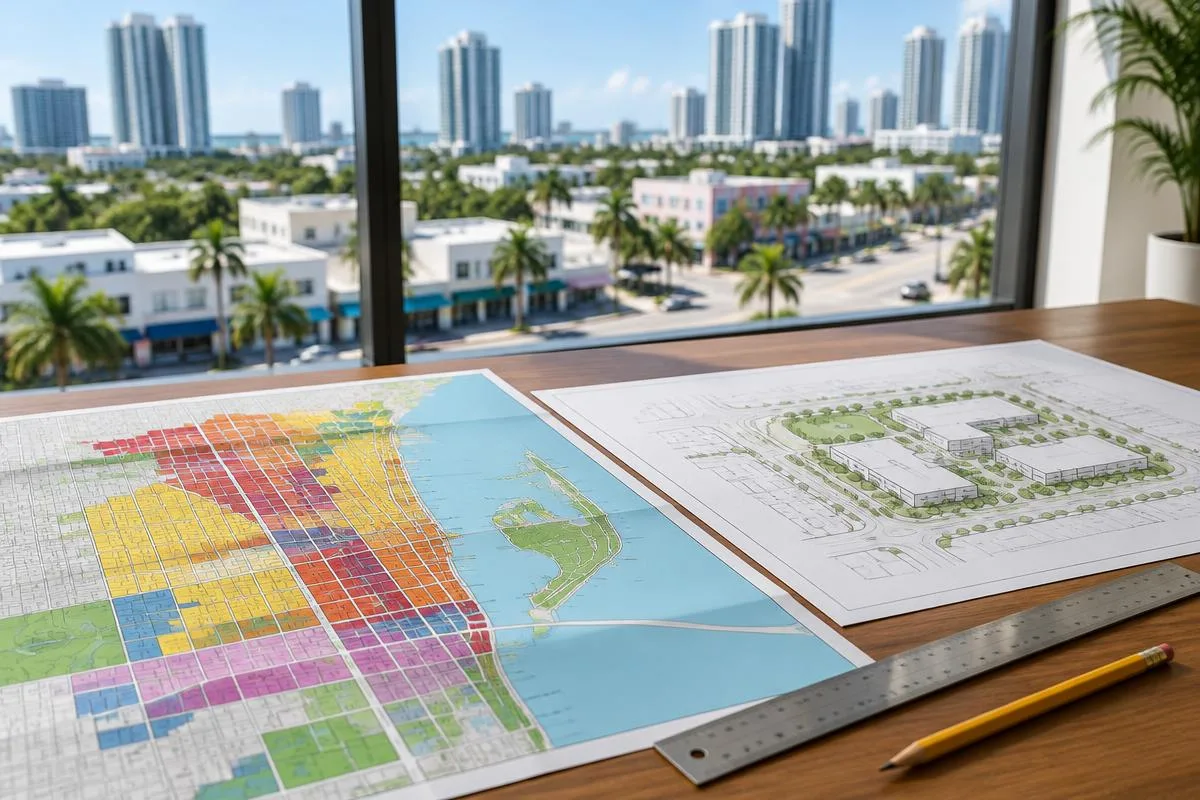
Understanding zoning is one of the most important steps when buying, selling, or developing commercial real estate in the City of Miami.
A property's location, size, and asking price may make it attractive, but zoning can determine whether a buyer can operate a particular business, renovate an existing building, or pursue a new development project.
For commercial property owners, zoning can also influence how a property should be marketed and which buyers are most likely to be interested.
In the City of Miami, the primary zoning framework is known as Miami 21.
Unlike traditional zoning systems that focus primarily on separating land uses, Miami 21 is a form-based zoning code that also regulates building design, development intensity, frontage, and the relationship between buildings and surrounding streets.
For buyers evaluating retail buildings, mixed-use properties, commercial land, or redevelopment opportunities, understanding the basics of Miami 21 can help identify potential opportunities and avoid costly assumptions.
As a commercial real estate professional working with property owners, landlords, and business owners in Miami, I believe zoning should be evaluated early in the transaction rather than treated as a detail to address after signing a contract.
Here is what commercial buyers and sellers should understand about Miami 21 and how it can affect property value, permitted uses, and development potential.
1. What Is Miami 21 Zoning, and Why Does It Matter for Commercial Real Estate?
Miami 21 is the City of Miami's form-based zoning code, which establishes standards for land use, building configuration, development intensity, and new construction or redevelopment.
The code was adopted in 2009 and has been amended over time.
It uses an official zoning atlas to assign a zoning designation to properties within the City of Miami.
These designations help determine which uses may be allowed, what type of development may be considered, and which building standards apply.
Miami 21 regulates more than whether a property can be used for retail, office, residential, or other activities.
Depending on the designation, it may also regulate:
- Building height and configuration.
- Density and development intensity.
- Setbacks and building placement.
- Parking requirements.
- Frontage and streetscape standards.
- Permitted uses and approval procedures.
- Landscaping and public-space relationships.
Does Miami 21 apply throughout Miami-Dade County?
No. This distinction is particularly important for commercial buyers and sellers.
Miami 21 applies within the City of Miami, not automatically throughout Miami-Dade County.
Properties in municipalities such as Coral Gables, Doral, Hialeah, Miami Beach, and other cities are generally subject to their respective zoning regulations.
Properties in unincorporated Miami-Dade County are subject to the county's applicable land development regulations.
A property with a Miami mailing address is not necessarily within the City of Miami.
Before evaluating zoning, the first step is to identify the property's actual governing jurisdiction.
2. What Do T3, T4, T5, and T6 Mean in Miami 21 Zoning?
Miami 21 uses transect zones to organize different development environments, ranging from lower-intensity neighborhoods to more intensive urban centers and cores.
A transect designation helps describe the general character and intensity of development anticipated for an area.
The major transect categories commonly encountered in property research include T3, T4, T5, and T6.
Understanding the main Miami 21 zoning categories
| Zoning Category | General Description | Commercial Real Estate Considerations |
|---|---|---|
| T3 – Sub-Urban | Primarily lower-intensity residential environment | Commercial opportunities are generally more limited |
| T4 – General Urban | Urban neighborhood environment with varying permitted uses | Some subcategories may accommodate commercial or mixed-use activity |
| T5 – Urban Center | More intensive urban environment | Certain subcategories allow commercial and mixed-use development |
| T6 – Urban Core | Higher-intensity urban environment | May accommodate more intensive mixed-use development, subject to applicable regulations |
| D1 – Work Place | District with workplace-oriented functions | Specific commercial and industrial uses require code review |
| D2 – Industrial | Industrial district | Industrial and related permitted uses must be verified |
| D3 – Marine | Marine-oriented district | Marine-related uses and other permissions depend on code provisions |
The zoning category alone does not establish everything that can be done with a property.
Miami 21 includes additional designations, subcategories, overlays, and regulations that can affect permitted uses and development standards.
What do R, L, and O mean?
Certain Miami 21 transect zones have suffixes that distinguish different levels of permitted use.
These commonly include:
- R — Restricted: A more restricted range of permitted functions.
- L — Limited: A broader but still limited range of functions.
- O — Open: A broader range of permitted functions within the applicable zone.
For example, T5-R, T5-L, and T5-O should not be assumed to allow identical commercial uses.
The same distinction is relevant in other transect categories.
A buyer should always verify the complete zoning designation rather than relying only on the first two characters.
3. How Can You Find the Zoning Designation of a Commercial Property in Miami?
You can begin by searching the City of Miami's zoning GIS system using the property address or folio number, then verifying the applicable designation and regulations.
The City provides zoning information through its official resources.
However, online maps are research tools and may not reflect every current amendment or property-specific determination.
For transactions involving significant investment or development plans, additional verification may be appropriate.
How to check a property's zoning
- Confirm the jurisdiction. Determine whether the property is located within the City of Miami.
- Locate the property address or folio number. Use the correct parcel identification to avoid confusing neighboring lots.
- Access the City's zoning GIS. Search the property and review the zoning designation.
- Record the full transect designation. Include applicable suffixes and other relevant information.
- Review Miami 21 Article 4, Table 3. Determine whether the intended use is permitted by right, requires special approval, or is prohibited.
- Review development standards. Evaluate the applicable rules for height, density, setbacks, parking, and other relevant requirements.
- Investigate overlays and special regulations. Determine whether additional restrictions or provisions apply.
- Request official verification when appropriate. For significant acquisition or development decisions, obtain confirmation from the City and qualified professionals.
The City notes that a zoning verification letter may provide the most authoritative confirmation of a property's zoning designation.
Official resources
Buyers should not rely exclusively on a property's advertised zoning designation when the intended use or development potential is essential to the purchase.
4. What Commercial Uses Are Allowed Under Miami 21?
The commercial uses allowed under Miami 21 depend on the property's specific transect designation, applicable use classification, and any additional approval requirements.
A property being described as commercially zoned does not mean every type of business can operate there.
Retail stores, restaurants, professional offices, medical offices, entertainment establishments, and other commercial activities may be classified differently under the code.
Some uses may be permitted by right, while others require a special approval process.
What does permitted by right mean?
A use permitted by right is generally allowed under the applicable zoning classification, subject to zoning review and compliance with other applicable requirements.
However, being permitted by right does not eliminate the need for building permits, certificates, inspections, or other approvals when required.
What is a Warrant or Exception?
Miami 21 uses different approval procedures for certain uses.
| Designation in Use Table | General Meaning |
|---|---|
| R | Use allowed by right |
| W | Use requires a Warrant |
| E | Use requires an Exception |
| Blank | Use is generally prohibited under that designation |
A Warrant is generally an administrative approval process for specified uses.
An Exception generally involves a public hearing process and may require additional governmental approval depending on the application.
The requirements and likelihood of approval depend on the applicable code and property circumstances.
Example: Purchasing a property for a restaurant
Consider a buyer interested in purchasing a vacant retail building along SW 8th Street for a restaurant.
Before proceeding, the buyer should investigate whether the intended restaurant use is allowed under the property's zoning designation.
The buyer may also need to evaluate:
- Whether the proposed food-service use requires special approval.
- Building occupancy and life-safety requirements.
- Parking requirements or applicable relief.
- Kitchen exhaust and ventilation.
- Grease management and wastewater requirements.
- Existing permits and the property's legal use.
- Other applicable city, county, and state approvals.
The fact that a previous tenant operated a restaurant does not automatically guarantee that a new restaurant concept can open without additional review.
This is why zoning verification should be part of the acquisition process.
5. How Does Miami 21 Affect Building Height, Density, and Development Potential?
Miami 21 can influence the development potential of a property through its rules governing building height, density, configuration, setbacks, and other development standards.
For commercial land buyers and sellers, these regulations may significantly affect how a property is evaluated.
However, zoning potential should not be confused with guaranteed development approval.
How do T6 height designations work?
Certain T6 designations include a number associated with the base maximum building height in stories.
For example, T6-8 and T6-12 generally indicate different base height allowances.
However, a parcel's actual development potential may be affected by additional provisions, including applicable benefits, overlays, site conditions, airport restrictions, and other requirements.
The zoning label alone is not a complete development analysis.
Why density is different from height
Height generally concerns how tall a building may be.
Density concerns the permitted intensity of residential development, including the number of dwelling units allowed under applicable regulations.
Other standards can affect the amount and configuration of development, such as lot coverage, floor area, setbacks, open space, and parking.
A property that allows a certain building height does not necessarily support the maximum number of residential units a buyer hopes to construct.
Example: Commercial land with multifamily potential
Suppose an owner has a commercial parcel in the City of Miami and wants to market it as a possible multifamily development opportunity.
Before advertising a specific unit count, the owner should verify:
- The full zoning designation.
- Applicable density regulations.
- Lot dimensions and survey information.
- Minimum lot and frontage requirements.
- Height and setback restrictions.
- Parking and access requirements.
- Relevant overlays or special district provisions.
- Whether any proposed incentives or alternative approval programs apply.
An architect, land-use attorney, or other qualified professional may need to conduct a feasibility analysis.
For sellers, accurate development information can help attract buyers while reducing the risk of overstating what can be built.
6. Can Miami 21 Zoning Increase or Decrease Commercial Property Value?
Yes. Zoning can influence commercial property value because it affects the uses, development possibilities, and restrictions associated with the land.
A property that accommodates several desirable uses may attract a broader buyer audience than a property with more limited permitted uses.
However, broader zoning permissions do not automatically mean a higher market value.
Location, market demand, property condition, acquisition cost, and development feasibility also matter.
How zoning can affect different buyers
Owner-users: A business owner may value a property that accommodates the intended business without requiring a complicated approval process.
Investors: An investor may consider whether the zoning supports continued leasing, alternative tenants, or future repositioning.
Developers: A developer may evaluate allowable density, building height, site configuration, and other requirements that influence project feasibility.
Landlords: A landlord may consider how the permitted-use range affects the pool of potential tenants.
For example, a retail property with zoning that accommodates several commercially viable uses may offer more leasing flexibility than one with narrower permissions.
However, that flexibility should be verified before it is included in marketing materials.
How should sellers present zoning information?
Commercial property listings should identify the applicable zoning designation accurately and distinguish existing permitted uses from proposed future uses.
If a redevelopment concept requires additional approvals, the marketing should make that clear.
Statements such as "approved for 50 units" should not be used unless the relevant approvals have actually been obtained and remain applicable.
For owners considering a sale, a commercial property valuation and market analysis can help evaluate how zoning fits into the property's overall market position.
7. What Zoning Due Diligence Should Commercial Buyers Complete Before Closing?
Commercial buyers should verify the property's zoning designation, existing legal use, proposed use, development limitations, and relevant permit or approval requirements during the contractual due diligence period.
Zoning due diligence is especially important when the buyer intends to change the property's use, renovate the building, or pursue redevelopment.
Commercial zoning due diligence checklist
- Confirm the property is within the correct governing jurisdiction.
- Verify the full zoning designation.
- Review the applicable Miami 21 permitted-use table.
- Determine whether the intended use is allowed by right.
- Identify any required Warrants, Exceptions, or other approvals.
- Verify the property's existing legal use and available certificates.
- Review open permits and code enforcement records.
- Evaluate building height and density limitations.
- Review setbacks, frontage, parking, and access requirements.
- Check historic preservation or other applicable overlays.
- Evaluate relevant environmental and infrastructure constraints.
- Consult an architect or land-use professional for development feasibility.
- Review contractual due diligence deadlines with a Florida real estate attorney.
- Obtain official zoning verification when appropriate.
What about the Florida Live Local Act?
Certain qualifying affordable housing developments may be eligible for special treatment under Florida's Live Local Act and applicable implementing requirements.
The City of Miami has published guidance addressing eligibility and development standards.
However, not every commercial parcel qualifies.
Eligibility can depend on the zoning designation, proposed project, affordability requirements, and other applicable conditions.
Buyers and sellers should not assume that the Live Local Act permits unrestricted multifamily development on every commercial property.
A project-specific review is essential.
8. How Should Commercial Property Owners Use Zoning Information When Selling?
Commercial property owners should verify zoning before listing and use accurate information to identify potential buyers, explain property opportunities, and avoid unsupported development claims.
A well-prepared commercial listing should communicate what the property is today and, where appropriately supported, what alternative uses may be worth evaluating.
My approach to evaluating zoning for a commercial listing
- Identify the property and jurisdiction. Confirm the parcel information and governing zoning authority.
- Review the existing zoning designation. Determine the property's classification and relevant regulations.
- Understand the current use. Review whether the existing operation is legally established and whether any relevant records need verification.
- Identify potential buyer categories. Consider investors, owner-users, developers, and other buyers whose objectives may align with the property.
- Evaluate development potential carefully. Distinguish permitted development from projects requiring additional approvals.
- Prepare accurate marketing materials. Present verified zoning information without promising unapproved uses or unit counts.
- Coordinate buyer questions. Direct technical questions to the appropriate zoning, design, legal, or governmental professionals.
- Support due diligence. Help organize available property information and facilitate the buyer's review process.
What Zoning Mistakes Should Commercial Buyers and Sellers Avoid?
Zoning assumptions can create problems when buyers or sellers rely on incomplete information.
Here are six common mistakes:
- Assuming Miami 21 applies throughout Miami-Dade County. Different municipalities and unincorporated areas have their own zoning regulations.
- Relying only on a property's advertised zoning description. The full designation and current regulations should be verified.
- Assuming every commercial use is permitted. Restaurants, offices, entertainment uses, and other businesses may be treated differently.
- Confusing building height with allowable density. A height designation does not establish the number of residential units that can be constructed.
- Advertising unapproved development potential as guaranteed. Proposed uses and unit counts may require additional review or approvals.
- Waiting until after closing to verify zoning. Buyers should evaluate critical zoning requirements within their contractual due diligence period.
Zoning can create opportunities, but it also establishes limitations that should be understood before a major financial commitment.
Buying or Selling Commercial Property in the City of Miami?
Whether you are evaluating a retail building, shopping center, commercial land, mixed-use property, or redevelopment opportunity, understanding zoning is an important part of making an informed real estate decision.
I can help you evaluate the property's market position, identify relevant buyer or investment considerations, and coordinate the information needed to assess the opportunity.
If you are a property owner considering a sale, learn more about my commercial property sales and listing representation services.
If you are an investor searching for opportunities, explore my commercial real estate investment and buyer representation services.
Contact me for a free commercial property consultation to discuss your objectives and next steps.
---
*This article is intended for general educational purposes and does not constitute legal, architectural, engineering, zoning, or development advice. Miami 21 and other applicable regulations may be amended. Permitted uses, density, height, parking, development incentives, and approvals must be verified for each property with the appropriate government agencies and qualified professionals.*
Authoritative references for this topic
Primary government, regulatory and industry sources readers can consult directly. This article is educational and is not legal, tax, or investment advice.
- Uniform Standards of Professional Appraisal Practice (USPAP) — The Appraisal Foundation
- Miami 21 Zoning Code and Zoning Information — City of Miami Planning Department
- Live Local Act — Affordable Housing Incentives and Land Use Provisions — Florida Housing Finance Corporation
- PortMiami Cargo and Trade Statistics — Miami-Dade County / PortMiami
Lais Same
Lais Same is a commercial real estate broker serving Miami and South Florida, representing property owners, landlords, investors, buyers, and tenants in commercial property sales, leasing, investment transactions, valuation, and market analysis. Learn more about Lais Same or discuss a commercial property.
 Buying
How to Analyze a Commercial Property Before You Buy: A Checklist for Investors
A practical due diligence checklist for Miami investors: income and expenses, cap rate and DSCR, leases and vacancy risk, inspections, zoning, and financing.
 Selling
Commercial Listing Agreements Explained: Exclusive Right to Sell, Term and Commission
What Miami commercial property owners should review before signing a listing agreement: listing type, term, commission, protection periods, and termination.
 Selling
How to Price a Commercial Property for Sale Without Leaving Money on the Table
How Miami commercial property owners can set a supportable asking price using comparable sales, income analysis, lease review, and buyer targeting.
Need advisory on a specific property or market?
Speak directly with Lais about your leasing, acquisition, or investment goals in South Florida.
Schedule a Consultation