What Is a Good Cap Rate in Miami Commercial Real Estate?
What cap rates mean for Miami retail, office, industrial, and multifamily properties, how to calculate value from NOI, and what to review beyond the number.
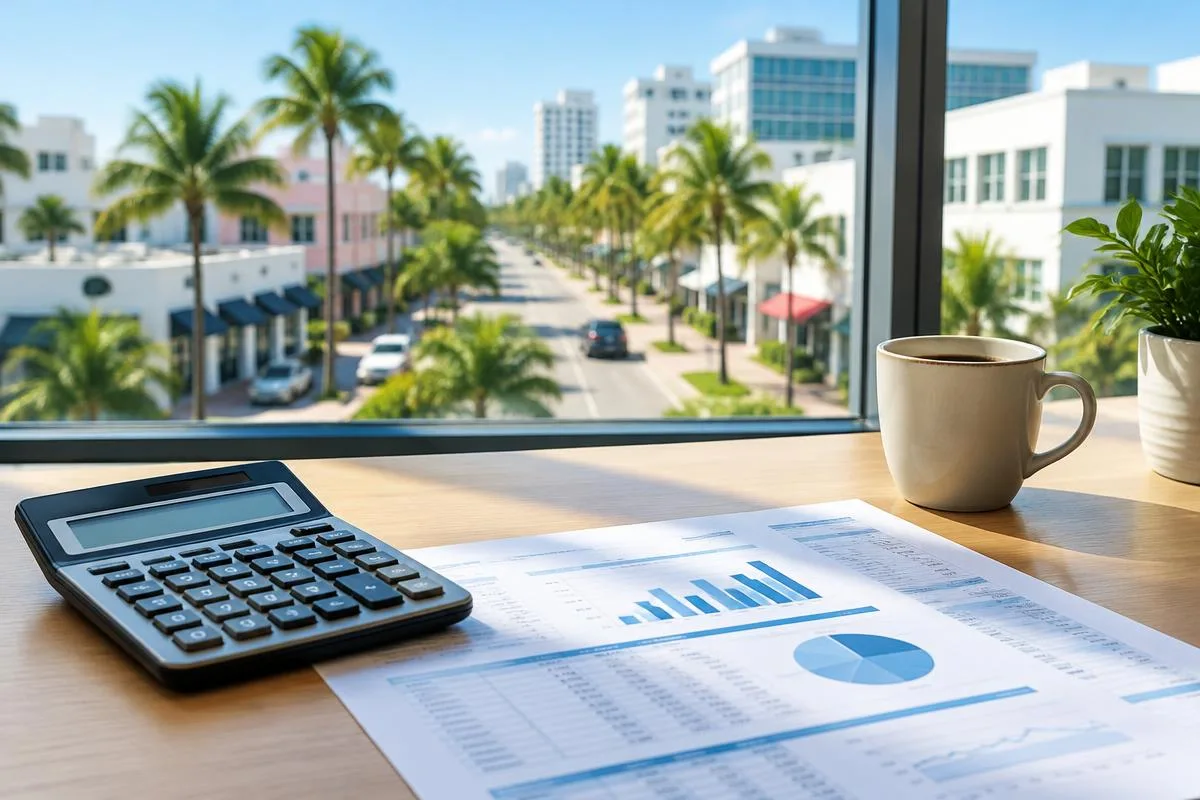
If you are considering buying or selling an investment property in Miami, one of the first numbers you will likely encounter is the capitalization rate, commonly known as the *cap rate*.
Commercial real estate investors use cap rates to evaluate how much income a property generates relative to its purchase price or market value.
But what is considered a good cap rate in Miami?
The answer depends on the property type, location, tenant quality, lease terms, building condition, and the level of risk an investor is willing to accept.
A retail shopping center with established tenants may have a different cap rate from a vacant office building, industrial warehouse, or multifamily investment property.
Even properties within the same neighborhood can trade at different cap rates because of differences in rental income, operating expenses, and future expectations.
A good cap rate is not necessarily the highest cap rate. It is a rate that appropriately compensates an investor for the property's income, risks, and acquisition price.
As a commercial real estate professional working with investors, landlords, and property owners in Miami and South Florida, I believe understanding cap rates is essential when evaluating an investment opportunity or determining how to position an income-producing property for sale.
Here is how cap rates work, what influences them in Miami, and how investors can use them to make better-informed decisions.
1. What Is a Cap Rate in Commercial Real Estate?
A capitalization rate measures a property's annual net operating income as a percentage of its purchase price or market value.
It is one of the most widely used metrics for evaluating income-producing commercial real estate.
The formula is:
Cap Rate = Annual Net Operating Income ÷ Property Value × 100
For example, suppose a commercial property generates $120,000 in annual net operating income and is offered for sale at $2,000,000.
The calculation would be:
$120,000 ÷ $2,000,000 × 100 = 6%
The property has a 6% cap rate based on those assumptions.
This means its annual net operating income equals 6% of the stated property price.
However, a 6% cap rate is not the same as a guaranteed 6% investment return.
Cap rates generally exclude financing costs, income taxes, and capital expenditures. They also do not account for future changes in occupancy, rental income, or property value.
What is net operating income?
Net operating income, or NOI, represents income from property operations after deducting operating expenses.
A simplified calculation is:
NOI = Effective Gross Income − Operating Expenses
Operating expenses may include property taxes, insurance, maintenance, property management, and utilities paid by the owner.
NOI generally excludes mortgage payments, depreciation, income taxes, and capital expenditures.
Before calculating a cap rate, investors should verify that the NOI reflects an accurate and consistent treatment of the property's income and expenses.
2. What Is Considered a Good Cap Rate in Miami?
A good cap rate in Miami is one that is competitive with relevant comparable investment properties and appropriately reflects the specific property's risks and income characteristics.
There is no universal cap rate that applies to every commercial property in Miami-Dade County.
A rate that is attractive for one type of investment may be inappropriate for another.
For example, a well-located retail property with established tenants and long-term leases may attract investors willing to accept a lower cap rate in exchange for more predictable income.
A property with significant vacancy, deferred maintenance, or near-term lease expirations may need to offer a higher potential yield to compensate investors for additional risk.
How should investors interpret different cap rates?
The following table illustrates how cap rates can affect an investment analysis.
| Illustrative Cap Rate | General Investment Consideration |
|---|---|
| 4% | Lower initial income yield; requires careful evaluation of price, income stability, and growth expectations |
| 5% | May be attractive for certain lower-risk assets, depending on market evidence |
| 6% | Requires comparison with property-specific risk and relevant transactions |
| 7% | Higher initial income yield, but may reflect additional risk |
| 8% or higher | Potentially stronger initial income yield, with a need to investigate why the yield is elevated |
These percentages are illustrative examples, not verified current Miami market cap-rate ranges or recommendations.
A property with an 8% cap rate is not automatically a better investment than one with a 5% cap rate.
The higher-cap-rate property may have weaker tenants, substantial repair requirements, or a greater risk of future vacancy.
The correct question is not simply, "Which property has the highest cap rate?"
It is, "Does the cap rate adequately reflect the property's income stability, condition, location, and risks?"
3. How Do Cap Rates Differ Between Retail, Office, Industrial, and Multifamily Properties in Miami?
Cap rates differ across commercial property types because investors evaluate income stability, tenant demand, operating expenses, and risk differently.
A retail shopping center does not have the same investment characteristics as a multifamily building or industrial warehouse.
Retail properties
Retail property cap rates can be influenced by tenant mix, location, lease duration, and operating expense responsibilities.
For example, a retail center with established tenants and predictable rental income may appeal to investors seeking income stability.
A property with multiple vacancies or tenants approaching lease expiration may present additional leasing risk.
In Miami, retail locations along corridors such as West Flagler Street and SW 8th Street may attract different types of tenants and investors depending on their visibility, accessibility, parking, and surrounding businesses.
Office properties
Office cap rates can be affected by occupancy, lease terms, building condition, and tenant demand.
Investors should consider whether the property can attract and retain office tenants and what improvements may be necessary between leases.
A partially vacant office building may require a different valuation approach from a fully leased property with stable income.
Industrial properties
Industrial investors often evaluate loading access, clear height, building configuration, location, and tenant requirements.
Lease structure and the potential cost of replacing a tenant can also influence investment risk.
An industrial property in Doral may have different demand characteristics from a smaller warehouse in another Miami-Dade submarket.
Multifamily properties
Multifamily cap rates are influenced by rental income, occupancy, operating expenses, building condition, and future capital requirements.
Investors should review actual rental collections, property taxes, insurance, maintenance, and the property's ability to maintain occupancy.
Older multifamily buildings may require additional capital expenditures that are not reflected in the advertised NOI.
Commercial property comparison
| Property Type | Key Factors Affecting Cap Rates |
|---|---|
| Retail | Tenant mix, lease terms, vacancy, location, operating expense reimbursements |
| Office | Occupancy, tenant demand, improvements, lease rollover |
| Industrial | Building functionality, location, tenant quality, lease structure |
| Multifamily | Rental income, occupancy, expenses, property condition |
| Mixed-use | Combined income streams, tenant diversity, operating complexity |
Investors should compare cap rates primarily with properties that share relevant characteristics, rather than comparing unrelated asset types.
4. Why Do Some Miami Commercial Properties Have Higher Cap Rates Than Others?
Higher cap rates often reflect greater perceived risk, lower growth expectations, or a purchase price that is relatively low compared with current NOI.
Several factors can explain why two properties generate different cap rates.
Tenant quality: Investors may place greater value on income from financially stable tenants, although tenant strength should be evaluated rather than assumed.
Lease duration: Properties with leases expiring soon may carry additional vacancy or renegotiation risk.
Property condition: Buildings requiring substantial repairs may need to offer a higher yield to attract buyers.
Location: Accessibility, surrounding development, tenant demand, and market conditions influence investor expectations.
Income sustainability: A property with unusually high rental income may appear attractive until the leases are compared with current market rents.
Operating expenses: Property taxes, insurance, maintenance, and management costs affect NOI.
Financing conditions: Interest rates and the availability of financing can influence what investors are willing to pay.
Example: Two properties with different risk profiles
Imagine two hypothetical retail properties in Miami.
Property A has long-term tenants, limited deferred maintenance, and relatively predictable operating expenses.
Property B has several leases expiring within the next year and requires substantial building improvements.
Even if both generate similar current NOI, buyers may require a higher cap rate for Property B because of the additional uncertainty.
This does not mean Property B is necessarily a poor investment.
It may appeal to an investor who is comfortable with leasing risk and has a realistic strategy for improving the property.
The important point is that cap rates should be interpreted alongside the property's actual operating conditions.
5. How Do You Calculate Commercial Property Value Using a Cap Rate?
Investors can estimate the value of an income-producing property by dividing its annual net operating income by a market-supported capitalization rate.
The formula is:
Estimated Property Value = Annual NOI ÷ Cap Rate
For example, suppose a commercial property generates $150,000 in annual NOI.
Its indicated value changes depending on the capitalization rate applied.
| Assumed Cap Rate | Indicated Property Value |
|---|---|
| 5% | $3,000,000 |
| 6% | $2,500,000 |
| 7% | Approximately $2,142,857 |
| 8% | $1,875,000 |
These figures are hypothetical and illustrate the mathematical relationship between NOI, cap rate, and value.
Why does a lower cap rate produce a higher value?
When NOI remains constant, a lower cap rate results in a higher indicated property value.
A higher cap rate results in a lower indicated value.
This is why selecting the correct capitalization rate is so important.
For commercial property owners considering a sale, an unsupported cap rate can create unrealistic pricing expectations.
For buyers, applying a cap rate that is too low can lead to overpaying for the property's income.
A valuation should use relevant market evidence and account for the property's specific characteristics.
If you are considering selling an income-producing property, my commercial property valuation and market analysis services can help you evaluate its market position.
6. Is a Higher Cap Rate Better for Commercial Real Estate Investors?
A higher cap rate indicates a higher initial unleveraged income yield relative to the property's price, but it does not automatically mean the investment is better.
Investors must evaluate why the cap rate is higher.
For example, a property with an attractive advertised cap rate may have several tenants approaching lease expiration.
If those tenants leave, the property's income could decline significantly.
Similarly, a building with deferred maintenance may require major capital expenditures shortly after purchase.
Those expenses may not be reflected in the cap rate calculation.
What should investors review beyond cap rate?
- Actual rental collections: Verify that the income shown in the rent roll is being collected.
- Lease expiration schedule: Identify upcoming vacancies and renewal risks.
- Tenant financial strength: Evaluate relevant information about tenant stability.
- Operating expenses: Confirm that the property's NOI reflects realistic costs.
- Capital expenditures: Estimate roof, HVAC, structural, and other major improvement needs.
- Financing: Analyze interest rates, debt service, and lender requirements.
- Market rents: Determine whether current rents are above or below market-supported levels.
- Future cash flow: Model potential vacancy, expenses, and leasing costs.
A property with a lower cap rate and stable income may align better with a conservative investment strategy.
A higher-cap-rate property may offer opportunities for an investor willing to accept greater uncertainty.
Neither outcome is guaranteed.
7. What Is the Difference Between Cap Rate and Cash-on-Cash Return?
Cap rate measures property-level income relative to price, while cash-on-cash return measures annual before-tax cash flow relative to the investor's actual cash invested.
These metrics are related but answer different questions.
Cap rate
Cap Rate = NOI ÷ Property Value
Cap rate does not directly account for the investor's mortgage payments.
Cash-on-cash return
Cash-on-Cash Return = Annual Before-Tax Cash Flow ÷ Total Cash Invested
Cash-on-cash return considers financing because mortgage payments affect the cash available to the investor.
Hypothetical example
Assume an investor purchases a commercial property for $2,000,000.
The property generates $120,000 in annual NOI.
The investor obtains financing and has the following costs:
| Investment Item | Amount |
|---|---|
| Purchase price | $2,000,000 |
| Annual NOI | $120,000 |
| Loan amount | $1,300,000 |
| Down payment | $700,000 |
| Closing costs and initial investment expenses | $50,000 |
| Total cash invested | $750,000 |
| Annual debt service | $90,000 |
| Annual before-tax cash flow | $30,000 |
The cap rate is:
$120,000 ÷ $2,000,000 = 6%
The cash-on-cash return is:
$30,000 ÷ $750,000 = 4%
Both calculations describe the same hypothetical investment but measure different aspects of its performance.
The example assumes no additional cash expenditures beyond those shown.
Actual investor returns may be affected by capital expenditures, leasing costs, income taxes, changes in financing, and other factors.
Investors should evaluate both metrics rather than relying on only one.
8. How Should Miami Property Owners and Investors Use Cap Rates When Buying or Selling?
Commercial buyers and sellers should use cap rates as one part of a broader valuation and investment analysis, supported by verified financial information and relevant market comparisons.
For buyers, cap rates can help evaluate whether the purchase price is reasonable relative to income and risk.
For sellers, cap rates can help explain how an investment property's NOI relates to its asking price.
My recommended cap-rate analysis process
- Verify the property's income. Review the rent roll, leases, and available collection records.
- Confirm operating expenses. Evaluate property taxes, insurance, maintenance, management, and other costs.
- Calculate sustainable NOI. Distinguish actual income from optimistic projections.
- Review comparable transactions. Identify relevant income-producing properties that have sold.
- Evaluate property-specific risks. Consider tenant stability, vacancy, lease expirations, and condition.
- Select a market-supported cap rate. Avoid choosing a rate solely to justify a desired price.
- Estimate property value. Apply the selected rate to the appropriate NOI.
- Analyze financing and cash flow. Review debt service, cash-on-cash return, and required capital.
- Consider alternative scenarios. Model changes in occupancy, rental income, expenses, and exit assumptions.
- Review the complete investment strategy. Determine whether the property aligns with the investor's objectives and risk tolerance.
What Cap Rate Mistakes Should Investors Avoid?
Cap rates can be misleading when investors rely on incomplete financial information or make unrealistic assumptions.
Here are six common mistakes:
- Assuming the highest cap rate is always the best investment. Higher yields may reflect greater risk.
- Using gross rental income instead of NOI. Cap rates should be calculated using net operating income.
- Accepting the seller's NOI without verification. Income and expenses should be supported by available records.
- Ignoring property tax changes after acquisition. Future taxes may differ from the seller's current expenses.
- Overlooking capital expenditures. Major repairs can reduce actual investor returns even when they are excluded from NOI.
- Comparing unrelated property types. A retail property and an industrial warehouse may have different risk profiles and investor expectations.
A cap rate is a starting point for analysis, not a substitute for due diligence.
Looking to Buy or Sell Commercial Investment Property in Miami?
Whether you are evaluating a retail shopping center, office building, industrial warehouse, or multifamily investment property, understanding the cap rate is an important part of making an informed decision.
I can help you review commercial property opportunities, evaluate market positioning, and understand the financial information relevant to buying or selling.
If you are an investor, learn more about my commercial real estate investment sales and buyer representation services.
If you own an income-producing property and are considering selling, explore my commercial property sales and listing representation services.
Contact me for a free commercial property consultation to discuss your investment or selling objectives.
This article is intended for general educational purposes and does not constitute investment, appraisal, legal, tax, or financing advice. Cap rates, property values, financing terms, and market conditions vary by property and transaction. Illustrative calculations are not current Miami market benchmarks or guarantees of investment performance. Consult qualified professionals before making an investment decision.
Authoritative references for this topic
Primary government, regulatory and industry sources readers can consult directly. This article is educational and is not legal, tax, or investment advice.
- Publication 946 — How To Depreciate Property — U.S. Internal Revenue Service
- Uniform Standards of Professional Appraisal Practice (USPAP) — The Appraisal Foundation
- FEMA Flood Map Service Center — U.S. Federal Emergency Management Agency
- ADA Standards for Accessible Design (Places of Public Accommodation) — U.S. Department of Justice
Lais Same
Lais Same is a commercial real estate broker serving Miami and South Florida, representing property owners, landlords, investors, buyers, and tenants in commercial property sales, leasing, investment transactions, valuation, and market analysis. Learn more about Lais Same or discuss a commercial property.
 Buying
Miami 21 Zoning Explained for Commercial Buyers and Sellers
How Miami 21 affects commercial property: jurisdiction, transect zones, permitted uses, height and density, value, and a zoning due diligence checklist.
 Buying
How to Analyze a Commercial Property Before You Buy: A Checklist for Investors
A practical due diligence checklist for Miami investors: income and expenses, cap rate and DSCR, leases and vacancy risk, inspections, zoning, and financing.
 Selling
Commercial Listing Agreements Explained: Exclusive Right to Sell, Term and Commission
What Miami commercial property owners should review before signing a listing agreement: listing type, term, commission, protection periods, and termination.
Need advisory on a specific property or market?
Speak directly with Lais about your leasing, acquisition, or investment goals in South Florida.
Schedule a Consultation